Job Outlook for Geoscientists
Thinking about becoming a geoscientist?
Geoscientists :
- Search for mineral and energy resources
- Recognize the economic and environmental impacts of resource extraction and use.
- Study natural hazards and environmental geoscience to clean up and reclaim land.
- Research watershed science to maintain and manage clean water sources.
- Investigate global climate change and oceanography
- Communicate cutting-edge geosciences research to our communities.
- Explore planetary geology to understand planets like Mars.
Thinking of becoming a geosciences major?
Check out our video!
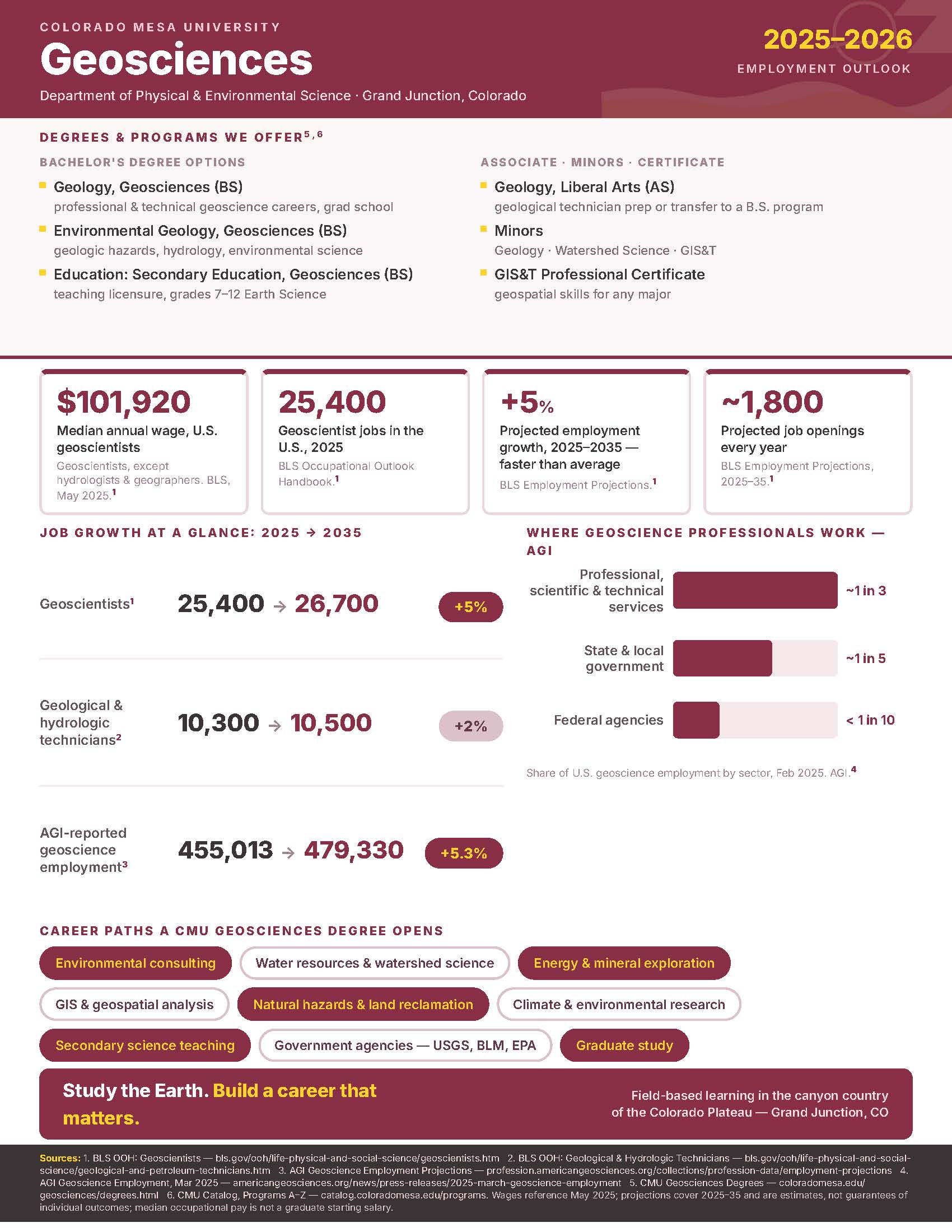
Geosciences Job Outlook
"Employment of geoscientists is projected to grow 5 percent from 2023 to 2033, about as fast as the average for all occupations. About 2,200 openings for geoscientists are projected each year, on average, over the decade. Many of those openings are expected to result from the need to replace workers who transfer to different occupations or exit the labor force, such as to retire."
"The latest employment projection data from the U.S. Bureau of Labor Statistics’ Employment Projections dataset indicates that geoscience employment is expected to grow by 3.7% over the coming decade, increasing from 461,152 in 2024 to 478,091 jobs in 2034. Explore the data on the Expected Increase in Geoscience Jobs 2024-2034 page."
Grand Junction Gem and Mineral Club Event Information
All geosciences students are welcome and encouraged to attend the bimonthly GJGMC meetings, field trips, and other events, including the fall Gem and Mineral show.
Geosciences Applauds Generous Geo-Fundraiser
The Grand Junction Gem and Mineral Club is home to outstanding members of our geo-community and promotors of education. Every year the Gem Club hosts events, including the Annual Grand Junction Gem, Mineral, and Jewelry Show, which draws in people from all over the rock-hound world. The fall show attracts more than 1500 attendees. These folks bring their dollars and leave with gem and mineral treasures!
The Gem Club has been raising money for scholarships and awarding them to our CMU Geosciences students since 1980. Between 1980 and 2024, the Club has generously awarded more than $40,000 in scholarships!
The Gem Club is an important economic contributor to our local economy. Importantly, from a CMU Geosciences perspective, the club is also a very generous supporter of education of CMU students. All of us at CMU Geosciences thank the Gem Club for their generosity, strong ties to our university, and commitment to education of our Western Slope youth.
Grand Junction Geological Society: Monthly Speaker Information
All geosciences students are welcome and encouraged to attend the monthly GJGS events.
The Grand Junction Geological Society (GJGS) is community of geosciences professionals, students, and local people with multiple geo-interests. At its monthly meetings, the GJGS hosts guest speakers, including CMU Geosciences faculty and alumni, on hot topics in the geosciences.
For many years, the GJGS and its individual members have been dedicated supporters of the CMU Geosciences Program. Since 2012, the GJGS has awarded $18,250 in student scholarships, $2375 in student-speaker awards, and $6500 in other financial support to the Geosciences program. Each spring, the GJGS typically awards five, annual $750 field-camp scholarships to defray the cost of attending the summer course. The Society has also generously purchased and donated tents and other course materials for field-camp students. Individual GJGS members have established endowments that provide scholarships for CMU students, including the endowed Forrest Nelson scholarship, which was initiated in 2018 with a donation of $600,000 and will provide scholarships to CMU geosciences students for many years to come.
Each spring, the GJGS also runs the William Chenoweth Memorial Field Trip. Members and CMU Geosciences faculty and students use this trip to meet and greet new outcrops and new folks in our geo-community here in Grand Valley.
The GJGS is a very generous supporter of education of CMU Geosciences students. All of us at CMU Geosciences thank the GJGS for their generosity, strong ties to our Geosciences students, and commitment to their education and professional development.
CMU Geosciences News - New Geo Faculty!
Welcome Marion McKenzie, PhD!
We’re delighted to welcome Dr. Marion McKenzie to the CMU Geosciences faculty! Dr. Marion McKenzie is primarily interested in subglacial processes and the ways in which records left at Earth's surface can tell us about ongoing process beneath modern ice sheets. She uses a wide range of tools including but not limited to GIS mapping, machine learning, sedimentology, geochronology, and geochemistry in her exploration of Earth's icy history. Her research has taken her to remote polar landscapes in places like Alaska and Greenland.
In the classroom, Dr. McKenzie brings the same curiosity and sense of discovery to her teaching. She recognizes that students arrive with different experiences and backgrounds, and she sees those perspectives as an opportunity to enrich exploration and learning. By meeting students where they are and connecting course material to the physical world around them, she helps make Earth science accessible, relevant, and exciting for everyone.
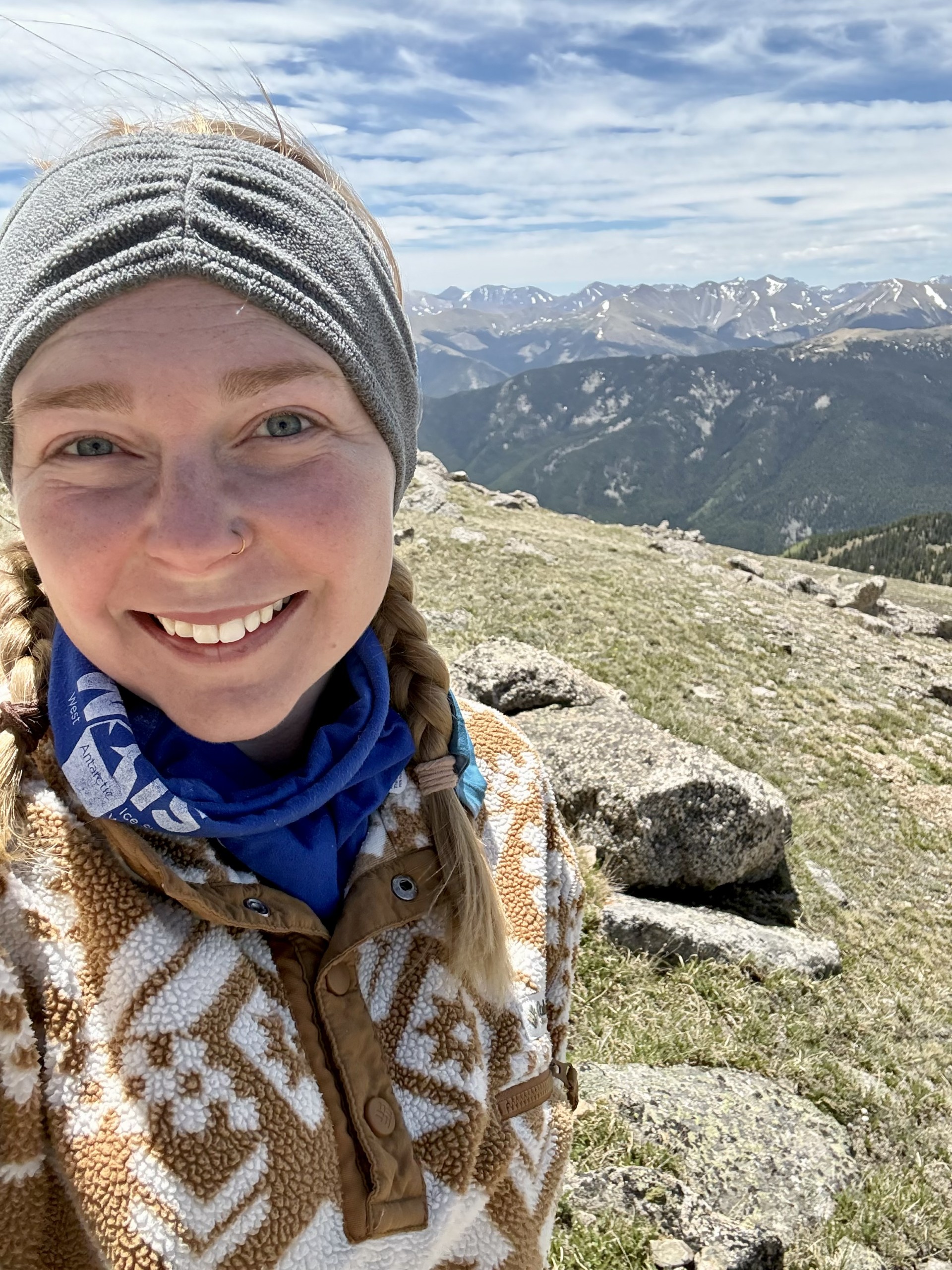
Dr. McKenzie welcomes conversations with our students. "If you’d like to chat about icy science or just want to say hello", swing by her office: Wubben 136A (Dr. Tellez's previous office!).
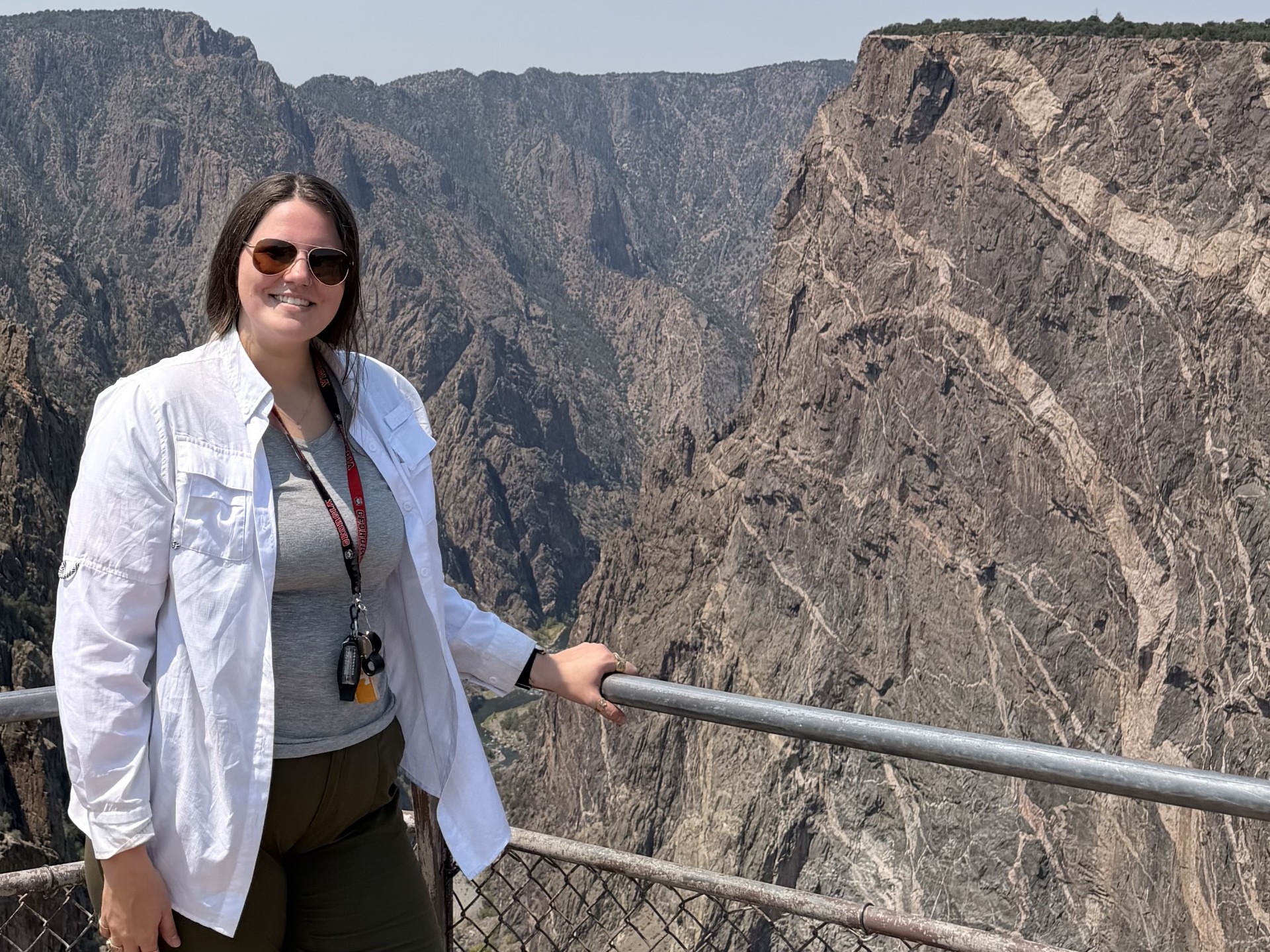
Welcome Morgan Lewis, PhD!
We’re thrilled to welcome Dr. Morgan Lewis, to the CMU Geosciences faculty! Dr. Lewis brings Earth and planetary science to life through hands-on demonstrations, current events, and real-world examples in courses ranging from groundwater and structural geology to weather and climate. She loves inspiring students to explore the natural wonders of our home planet—and our neighbors across the Solar System.
Her research takes her "all the way to Mars", where she uses data from the Curiosity rover to investigate how rocks fracture, whether groundwater once moved through those fractures, and what they reveal about the Red Planet’s geological and hydrologic history. From Earth to Mars, Lewis explores the fascinating intersection of structural geology and low-temperature geochemistry, uncovering how physical and chemical processes shape the rocks—and stories—they leave behind.