
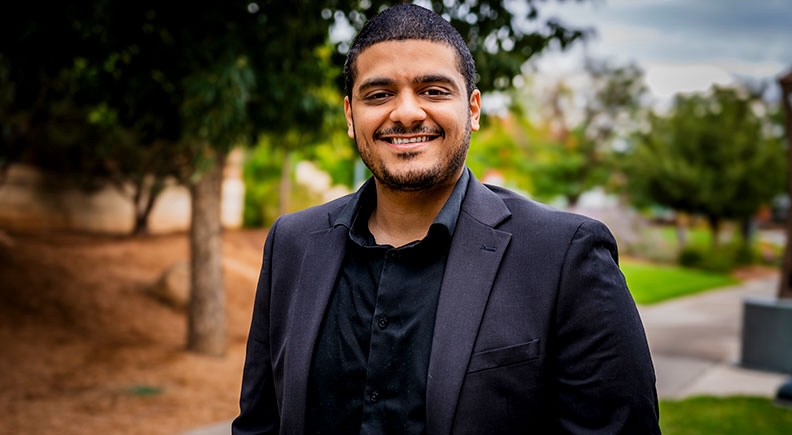
Davis School of Business Professor Abdulah Bajaba, DBA, combines psychology and business to teach students how people make decisions and adapt to change
With two rounds left in a conflict management exercise, students in Abdulah Bajaba's class weren't ready to leave.
The students were divided into four teams and had spent the class period making decisions, negotiating with one another and weighing the benefits of competition against cooperation. If every team cooperated, everyone benefited. But if one team chose to cooperate while the others competed, the cooperating team would lose.
Exercises like this are what makes Bajaba’s classroom unique. His classes include discussions, group activities and simulations that ask students to consider different perspectives and make decisions of their own.
Bajaba grew up in Saudi Arabia and came to the United States to pursue higher education. He originally planned to study medicine, but during his first semester, a psychology course altered his plans. His psychology professor was positive, interactive and engaging, which was a sharp contrast to his other classes that semester.
He eventually changed his major and ended up earning his bachelor's degree in psychology from Boston University. As he contemplated his next educational endeavor, Bajaba began considering how much of people's lives are spent at work. He was interested in how their relationships with employers, the expectations placed on them and their daily interactions could affect their well-being, even after they left work for the day.
Organizational behavior gave him a way to study those questions while combining his interests in psychology and business. He continued his education at Louisiana Tech University, where he earned his Master of Business Administration and Doctor of Business Administration.
His own experiences working and living in multiple countries and experiencing unfamiliar environments and perspectives contributed to that curiosity. Bajaba became interested in how people's responses to difficult situations could shape circumstances.
Today, his research focuses on antifragility, a concept that examines how individuals can become stronger through stress and disruption. He compares the concept to building muscle during a workout. During a workout, muscles experience stress. As they recover, they can become stronger over time. While resilience focuses on recovering after a difficult situation, antifragility considers how someone might grow because of it.
The idea also applies to businesses, where changing customer needs, new technologies and unexpected disruptions can force people to reconsider how they work.
Artificial intelligence is one recent example Bajaba has brought into his classroom.
In another class activity, he asked students to complete a force field analysis, examining the factors for and against adopting AI. They considered its ethical implications, questioned whether AI-generated information could be trusted and discussed whether relying too heavily on the technology might interfere with their own learning.
Bajaba believes AI can be a useful tool, but he wants students to understand its limitations and consider how to use it without giving up the thinking they're supposed to be doing themselves.
He encourages students to consider how AI can "expedite the process of learning rather than replace the process of learning."
Rather than simply explaining a theory and asking students to remember it, Bajaba often asks them to think about how it relates to situations they've encountered themselves. He wants to hear whether they agree with the material and how their own experiences might lead them to a different conclusion.
"I try to tailor the classroom based on what the student finds relevant," Bajaba said.
He enjoys hearing students share their own knowledge and experiences, and their questions and perspectives often give him something new to consider.
When Bajaba first arrived at CMU, he tried to introduce students to as many theories and concepts as possible. He enjoyed explaining complicated subjects and wanted students to understand as much of the material as they could.
"I love to explain complicated things in easy terms," Bajaba said.
But as he gained experience in the classroom, he began spending more time on fewer topics. He found that giving students a chance to work through the material in greater depth was more useful than trying to cover everything.
"If I can just let them go out of each class with one main topic that they truly understand, that they can apply in their life, then I've achieved everything that I want to achieve," Bajaba said.