
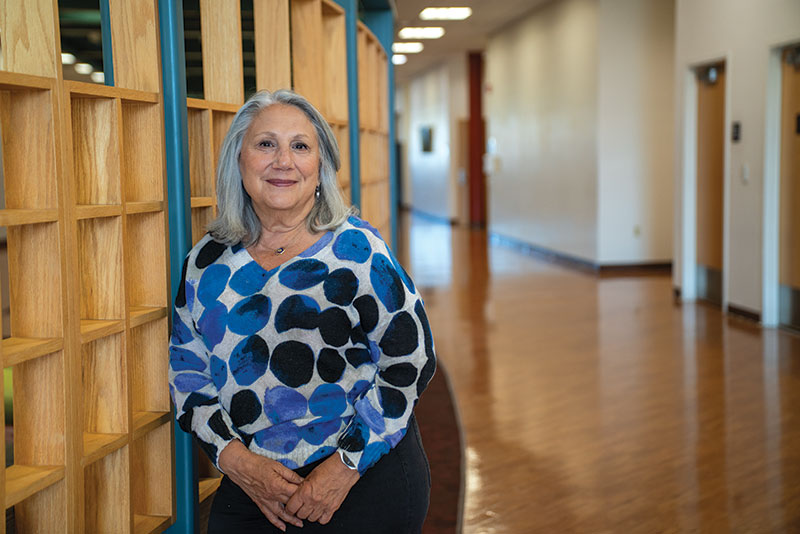
The longtime Davis School of Business professor looks back on the businesses, classroom projects and students that shaped more than three decades at CMU
Instructor of Business Georgann Jouflas grew up in a western Colorado family involved in sheep ranching. Business was so integral to her daily life that she did not initially consider it something she needed to study.
Her perspective changed when she took her first accounting class and began to understand how the different parts of a business worked together.
After earning a bachelor’s degree in international affairs from the University of Colorado, Jouflas moved to Washington, D.C., where she worked while earning her Master of Business Administration from George Washington University. She later joined a technology startup in Los Angeles as a product manager.
“I always wanted to do entrepreneurship, but that was before they even used the word,” Jouflas said.
When Jouflas returned to Grand Junction in 1990, two local restaurants were preparing to close. She decided to step in and, at age 29, became the owner and operator of River City Cafe and Dorothy’s Diner.
Her education and experience up to that point had provided a strong foundation, but running the restaurants required her to further widen her skill set.
“I had no idea what I was doing,” Jouflas said. “What I love about entrepreneurship is that it brings everything together. You have to know marketing, you have to know accounting and you have to know how they all interplay.”
While still operating both restaurants, Jouflas began what would become a 30+ year career teaching business at CMU. She would teach classes, then return to work at the restaurants.
Throughout her career, Jouflas also worked in food manufacturing and helped entrepreneurs through the Western Colorado Business Development Center, where she taught classes, reviewed business plans and helped launch a kitchen incubator.
Each experience shaped the way she taught. She gave students something to manage and taught them how to adjust if things didn’t go as planned. But Jouflas didn’t want students to learn only from her experiences. She wanted them to experience the uncertainty of running something themselves.
“You really cannot experience business unless you’ve actually been out there and done it,” Jouflas said.
One way she would nudge students into the business world was through a milestone project in which students were asked to start a business with limited funds. They found something to sell, tracked their expenses and learned whether people were interested in what they were offering.
Students sold food, delivered coffee and offered services like pet sitting. One began collecting used pallets, and the business eventually helped him pay for school.
Other students had ideas that didn’t work, but Jouflas never considered the efforts wasted.
“It’s okay to have some kind of failure because it makes you stronger,” Jouflas said. “And that’s such a beautiful thing to see people do.”
Students had to approach people, risk rejection and adjust when their original ideas didn’t work. They had to make decisions without knowing exactly what would come next. Jouflas calls that ability a “tolerance for ambiguity.”
“Life is always changing, and you have to get comfortable with that,” Jouflas said.
Jouflas also helped students practice their entrepreneurial skills on a larger scale through The Point. The former student-run coffee shop and bar began as a class project, with students researching the concept and helping open and operate the business across from campus. The Point later moved into the University Center and remained part of Jouflas’ classes for about 10 years.
Over the years, Jouflas has built a great deal of trust with her students. They’ve stopped by her office with questions, exchanged ideas and asked for advice on projects. Some have even returned to campus after graduation to share what they’ve been up to.
Jouflas is quick to add that the learning goes both ways.
“I learn more from them,” Jouflas said. “It’s amazing what you can learn.”
After more than three decades at CMU, Jouflas has watched former students become business owners and community leaders. She is proud of them but is reluctant to place herself at the center of their success.
“I don’t see myself as having a part,” Jouflas said. “I just really like seeing what they’ve done.”
Still, seeing where they are now has changed the way she looks back on her years at CMU. She has been at the university long enough to remember when some of today’s campus leaders were students themselves.
“I’m like, ‘Oh my God, you guys are running things now,’” Jouflas said.
As Jouflas looks at where her former students are now, she hopes the newest graduates carry one piece of advice with them as they begin their careers.
“Do something that brings you joy and have fun with it, but realize it’s going to take work,” Jouflas said. “You have to persevere.”
Jouflas is now beginning what she describes as a transitional retirement. Starting this fall, she will move from in-person to online teaching and spend more time in Eagle County helping manage her family’s industrial storage business.
Her role may be changing, but she plans to follow the same approach she has taught her students: stay curious, keep learning and adjust when circumstances change.
“The skills are always going to change,” Jouflas said. “But if you’re curious, you’ll learn the new skills.”