
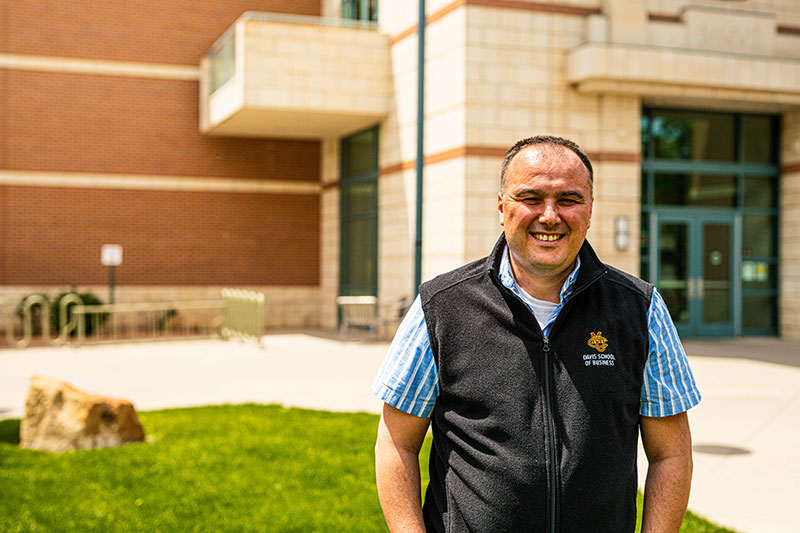
Davis School of Business professor Tevfik Demirciftci brings a global view to hospitality education
When Tevfik Demirciftci, PhD, talks to students about his experience in hospitality, he starts with the work.
For Demirciftci, that work has included fast food, restaurants, hotel reservations, revenue management, information technology and teaching in Turkey, Bahrain and the United States. Each role, including his first job in the U.S. at a Wendy’s in Pennsylvania, gave him a different view of an industry built around people and constant change.
Now an assistant professor of hospitality management at Colorado Mesa University’s Davis School of Business, Demirciftci uses those experiences to help students understand how broad and fast-changing the hospitality industry can be.
Originally from Turkey, Demirciftci began studying hospitality at Bilkent University in Ankara, where he earned a bachelor’s degree in hotel management. While he was still a college student, he came to the United States through a work-and-travel program. From there, his career continued to build across all corners of the hospitality industry.
He completed internships with Crowne Plaza and The Ritz-Carlton in Istanbul, earned a master’s degree in hospitality management from the University of Delaware and later worked in the information technology department at Borgata Hotel Casino & Spa in Atlantic City.
After the 2008 financial crisis, Demirciftci moved to Bahrain, where he worked for The Ritz-Carlton in reservations and revenue analysis. He later returned to Turkey and worked for Marriott’s Renaissance brand.
Over time, he became especially interested in the commercial and technology side of hospitality, including revenue management, finance, information systems and emerging technology.
Demirciftci has 22 years of experience in casinos, hotels and restaurants. He also holds two doctoral degrees, including a PhD in hospitality administration from the University of Nevada, Las Vegas, and a PhD in tourism management from Istanbul University.
He began teaching in 2014 at Özyegin University in Turkey, where he taught courses in hospitality robotics, revenue management and hospitality technology. At CMU, he talks with students about how robotics, artificial intelligence, self-service technology, and automation are already changing the industry.
Delivery robots, drones, smart rooms and AI-supported ordering systems have become part of a larger conversation about where hospitality is headed. For Demirciftci, those changes are part of the future his students will encounter.
“The thing that doesn’t change is change,” Demirciftci said. “College education is going to be a great foundation, but you have to always invest in yourself.”
Demirciftci teaches across hospitality operations, hospitality management strategies, hospitality information technology, sales and marketing, business analysis and management. As a Microsoft-certified Excel expert, he also teaches students how spreadsheets, data analysis, simulations and artificial intelligence connect to hospitality operations.
In his Hospitality Operations course, students use a hotel simulation to address department-level challenges and complete an eight-week shadowing experience across four major departments at Hotel Maverick. In another class, students work in teams to manage competing hotels, making decisions about revenue, operations, social media and financial performance.
“They want to have a hands-on experience instead of listening,” Demirciftci said. “They want to be part of that business. They want to engage.”
That approach is important, he said, because hospitality is much broader than hotels and restaurants. Graduates can work in lodging, restaurants, event management, convention centers, airlines, travel agencies, hospitality technology companies, human resources, sales, marketing or entrepreneurship.
“There are tons of things that you can do,” Demirciftci said.
That wide view of the industry comes from his own career. In Turkey and Bahrain, Demirciftci worked in hotels that served international travelers, athletes, politicians and Formula One guests. In Atlantic City, he saw the scale of the casino and resort industry. In Las Vegas, he studied hospitality in one of the world’s major tourism markets.
Those experiences help him show students how hospitality connects people, places and industries.
“The world is so much smaller,” Demirciftci said. “One person might know someone, and then it connects you.”
He sees that same network taking shape for CMU students. Former students have moved into roles in hotel management, revenue management, event management, airline work, short-term rental operations, digital marketing, hospitality management training programs and entrepreneurship.
Demirciftci wants students to understand that hospitality is a people-centered industry that also requires business knowledge, technology skills and the ability to adapt. He encourages students to complete internships, build practical skills and stay open to new opportunities, even when those opportunities do not look exactly like the career path they first imagined.
He knows from experience that one role can lead to another. A restaurant job can teach customer service, an internship can open a door and a hotel position can lead to careers across the business side of hospitality.
“Any experience is good experience,” Demirciftci said.
For Demirciftci, hospitality has always been a global career shaped by people, movement, technology and constant change.
Now, at CMU, he uses that experience to help students see where the industry can take them.
“I love teaching,” Demirciftci said. “I love to be with my students. I want to share my experiences because they are also teaching me.”