
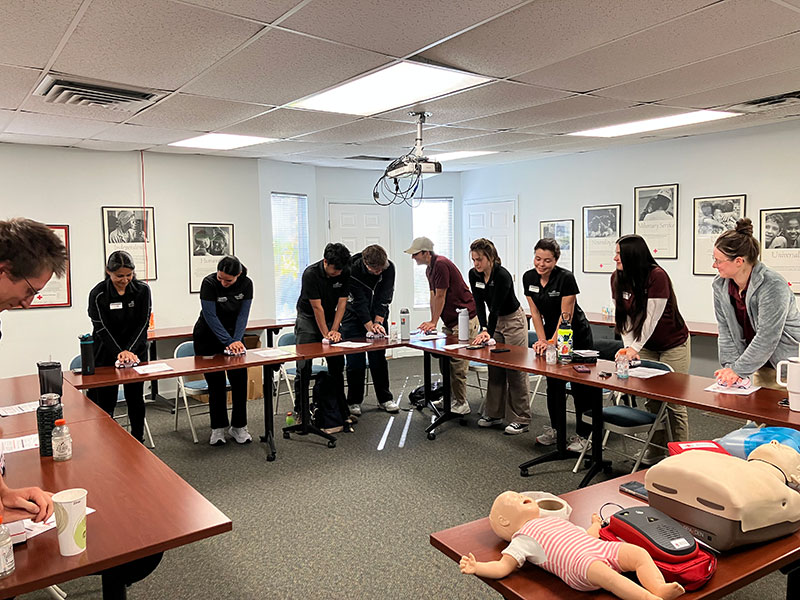
Each semester, Colorado Mesa University nursing students organize a health fair inside the University Center, where they set up CPR mannequins and ask students, staff and faculty passing by if they have a few minutes to practice a skill that could save a life.
At the CPR station, music plays at about 100 beats per minute to help participants find the right rhythm for chest compressions. Nursing students observe, reminding participants to keep their arms straight, push deep enough and adjust their speed when needed.
The health fair is one part of a nine-year partnership between CMU’s nursing program and the American Red Cross of Western Colorado.
The Red Cross experience is built into CMU’s Community and Population Health Nursing course, which students take during their final semester of the Bachelor of Science in Nursing (BSN) program. Much of their nursing education focuses on caring for individual patients, while this specific class teaches them to think about what happens when an emergency affects an entire community.
“This is the first time they’re exposed to it from a community and population level,” said Lucy Graham, associate professor and director of CMU’s Department of Health Sciences.
Graham described it as an “80,000-foot view” of how nurses can help keep communities and populations healthy.
In the early years of the partnership, students joined Red Cross volunteers to install smoke alarms in local homes and teach residents about fire safety. The work has evolved over time. Students now spend more time learning about disaster response, hands-only CPR and what nurses may encounter when people are displaced from their homes during disasters.
Christie Caster, executive director of the Red Cross of Western Colorado, said those situations don’t always come with a predictable set of problems. Red Cross volunteers emphasize a need to stay flexible, and the same is true in nursing. Students get a firsthand glimpse into what that work can look like from Red Cross volunteer Karen Bennett, a retired nurse who has been deployed to numerous disasters.
Bennett brings scenarios from her years of volunteer work with the Red Cross to the class and asks students how they would respond in each situation. One scenario might involve a resident who develops norovirus or another communicable illness. Students must think about caring for that person while also preventing the illness from spreading and keeping other shelter residents calm.
“You can only read so much in a book or hear a lecture so many times,” Caster said. “But just being able to have those two-way conversations with somebody who’s had the experience makes them really think about how they might apply that if they were in that situation.”
Students also learn hands-only CPR, giving them another chance to practice what they’ve learned and pass it along. The technique focuses on chest compressions during cardiac arrest. Brian Szabelski, regional communications manager for the American Red Cross of Colorado and Wyoming, said beginning compressions quickly can make a difference while emergency help is on the way.
At the health fair, students from any major can stop at the CPR station and practice on a mannequin. Graham said nursing students coach them through the speed and depth of each compression until they get a feel for the movement. The goal is to build muscle memory in case they ever face a situation where they need to use it on a real person. Once students learn the skill, that knowledge can spread beyond campus.
“Maybe you’re teaching your parents how to do it, maybe you’re teaching your cousins, your aunts and uncles,” Szabelski said. “You’re just getting that knowledge out there that somebody may need to know at some point.”
For the nursing students, teaching the skill to others reinforces what they have learned, too.
“See one, do one, teach one,” Graham said. “It’s reinforcing to learn something, to practice it and then to teach it.”
Nurses can volunteer through Red Cross disaster health services and deploy when communities need additional help. They may work in shelters, help someone replace medication or medical equipment left behind during an evacuation or care for people who are suddenly away from home without the resources they normally rely on.
Graham said nurses don’t have to work in emergency care in order to contribute useful skills during a disaster. Whether they work in labor and delivery, geriatrics, intensive care or another specialty, the skills they already have can be useful when communities need help.
“That skill set is needed in a disaster, doesn’t matter where it’s happening,” Graham said.
Graham said she has read reflections from students who came away from the experience newly interested in disaster response or Red Cross volunteer work.
“I think many of them said, ‘I never would have thought I wanted to do disaster response, and now I do,’” Graham said.
The relationship between CMU and the Red Cross has led to other projects as well. Nursing students recently helped check in donors during blood drives on campus, and Red Cross representatives spoke in a disaster and health class that included students from nursing, emergency management and other programs.
Both Caster and Graham have said they would like to find more ways for students to use their skills in the community, including preparedness education and other service projects.
For western Colorado, the broader view of nursing that CMU nursing students gain from the collaboration with the Red Cross can follow graduates into hospitals, public health departments, schools, outpatient care and, when disaster strikes, the communities that need them.