
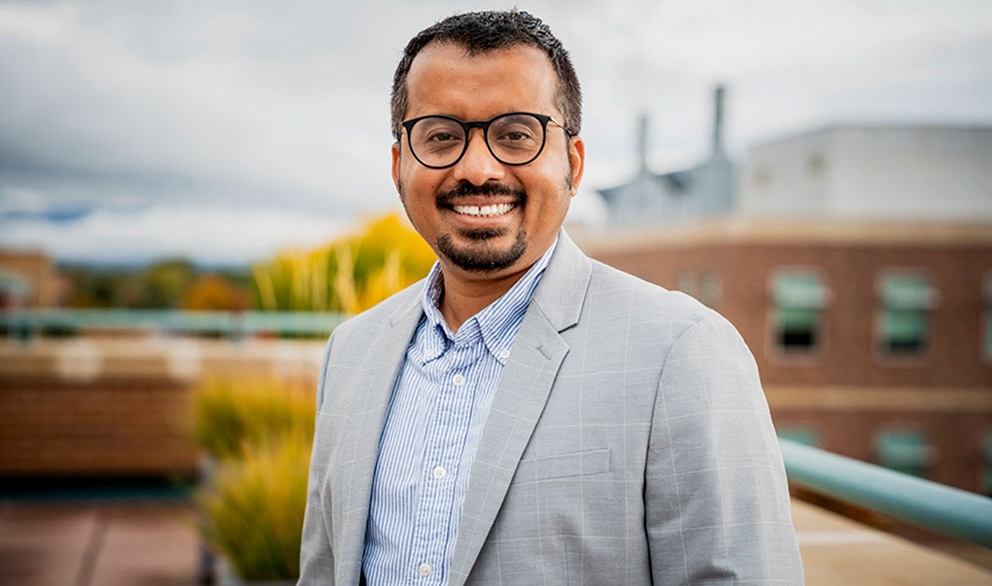
Drawing on his international experience and research in crisis management, the Davis School of Business professor challenges students to see the bigger picture in business
When aspiring entrepreneurs enter Shazzad Sikdar’s classroom at Colorado Mesa University’s Davis School of Business, some already have ideas about the kinds of businesses they’d like to start. Sikdar presents them with a different possibility. What if the business they dream of owning already exists?
As baby boomer business owners approach retirement, Sikdar sees an opportunity for the next generation of entrepreneurs. Through a collaboration with Sunbelt Business Brokers, students in his Business Strategy course evaluate existing companies using actual business data, ultimately determining whether they would purchase those businesses themselves.
“Most of my students say they never thought about this type of business,” Sikdar said.
With the help of Davis School of Business Executive Director Ben Williams, Sikdar developed the project to introduce students to entrepreneurship through acquisition. Business brokerage professionals visit his classroom to explain how companies are valued and what prospective buyers should consider before making a purchase.
For aspiring entrepreneurs, acquiring an established company can reduce some of the uncertainty associated with starting a business.
“They have a market, they have customers, they’re making money,” Sikdar said.
The project also introduces students to the role they could play in keeping businesses operating as their owners retire.
For Sikdar, an assistant professor of business management at CMU’s Davis School of Business, the project is part of a larger effort to teach students to think strategically. While their education prepares them to work in specialized areas of business, Sikdar challenges them to understand how an entire organization operates.
“You really need to think like a strategist, not a specialist,” Sikdar said.
His interest in strategy began in Bangladesh, where he worked as a financial analyst after earning his bachelor’s degree in business administration from the University of Dhaka. It was a career he had once dreamed of pursuing, but within six months, he realized he wanted to explore other possibilities.
Working in banking and telecommunications made Sikdar curious about what allows some companies to outperform their competitors. He had seen firsthand how the success of one department often depended on the work happening elsewhere in an organization.
Studying abroad had been a dream of Sikdar’s since high school. In 2016, he moved to the United States to earn his MBA at Eastern Illinois University. He continued his graduate studies at Washington State University, where he earned a second master’s degree and a PhD in strategic management.
After completing his doctorate, Sikdar joined CMU’s Davis School of Business, drawn to the university’s entrepreneurial culture and emphasis on student success. Western Colorado was also a natural fit for Sikdar, who enjoys camping, hiking and fishing in his free time.
As a researcher, Sikdar is fascinated by the decisions business leaders make when something goes wrong. Much of his research focuses on crisis management and product recalls, particularly those involving medical devices and pharmaceuticals.
When a company discovers a potentially harmful defect in one of its products, should its leadership initiate a recall before regulators intervene? How quickly should the company act? And how can it regain the confidence of its customers?
Sikdar examines how factors such as a CEO’s outlook or level of anxiety may influence the speed of a product recall. His research, which he has presented at conferences including the Academy of Management and the Babson College Entrepreneurship Research Conference, also explores how companies navigate crises across different cultures.
While publicly acknowledging a mistake and issuing an apology may help rebuild consumer confidence in the United States, Sikdar has found that the same approach may not be as effective in other countries.
“How you’re communicating and how that communication is perceived might be significantly different from culture to culture,” Sikdar said.
Those differences can also shape everyday business interactions. In his International Business course, Sikdar asks students to imagine presenting a business plan to employees in another country and receiving no feedback.
“Do not assume that it means it’s a fantastic plan,” Sikdar said.
Depending on the culture, employees may be reluctant to openly question their superiors. A manager unfamiliar with those differences could easily mistake silence for agreement.
In his Business Strategy capstone course, Sikdar uses a simulation in which students take responsibility for running their own companies. Accounting students must consider marketing decisions, while marketing students must weigh the financial implications of their plans.
“Any decision that you make, it ultimately affects other parts of business,” Sikdar said.
Even when presented with the same information, students may arrive at entirely different conclusions based on their judgment.
“The strategy is not a pure science, it’s an art,” Sikdar said.
For Sikdar, the usefulness of strategy extends beyond running a company. Just as businesses consider how to position their products in the marketplace, he asks students to think about how they can distinguish themselves in the eyes of potential employers.
Several former students have stayed in touch with Sikdar, sharing how they’ve applied lessons from his course to their own business ventures.
Last summer, he arrived at his office to find an envelope slipped under his door. Inside was a gift card and a thank-you note. He keeps notes like that alongside emails from former students, occasionally revisiting them for motivation.
For many of his students, Business Strategy is one of the last courses they take before graduating. As they begin their careers, Sikdar has one piece of advice he hopes they’ll remember.
“Always look for those opportunities to understand the business as a whole,” Sikdar said.