
CMU's History of Helping Veterans Transition from Military Service to Civilian Life
Zeth Taylor was adrift, perplexed by the realities of civilian life and struggling to find his path. After leaving the Army in 2020, he bounced around while exploring careers in Maine and Colorado — everything from a train conductor and a TSA officer to a boat captain. Nothing stuck.
Returning home to Baton Rouge where there was “nothing to do except eat and fish,” was not an option. In the back of his mind was his Army rotation in Iraq, where exhaustion and isolation took a toll: “I was mentally unwell.”
Fast forward to today, and Taylor, 27, is a long way from lonely. A sophomore at CMU, he walks among many fellow veteran students who, like him, have found a safe and supportive community. He’s also found a place to pursue his calling: social work.
“I want to help people,” he said.
Taylor is just one of many veterans on campus who have found community. The support circle dates back to CMU’s roots, particularly during the 1940s when the United States was on the brink of another World War. Each semester, about 300 of CMU’s students benefit from the array of campus services afforded to students who served in the military. Some come from faraway places. Many come from Mesa County, where more than 12,000 residents reported veteran status in 2023.
CMU During WWII
Throughout the decades, the nation’s involvement in global disputes has been an integral effector of CMU’s enrollment and in turn, life on campus. When the U.S. entered World War II in 1941, enrollment at what was once Mesa College, had reached 505 students; two years later, it plummeted to 150. Smaller but significant drops were recorded during the Korean and Vietnam wars. Through the 1940s, CMU’s history was mapped by key milestones that defined CMU as an educational institution.
It was during the World War II era when the institution signaled its strong commitment to providing support for service men and women, both on campus and those returning from duty.
When America’s participation in a global war was on the horizon, Mesa College’s registrar, Maurice Griffith, established a pilot training program. The initial course included “mechanical principles of aviation in ground school along with flight experience before solo flight,” according to college archives. Mary Elizabeth Hendrickson, one of the earliest students to enroll in the college’s Civil Aeronautics Authority, was known as the only woman to complete the course and earn a pilot’s license.
In 1942, Mesa College established a training class focused on mathematics and radio theory to prepare students for defense industry jobs or military service. For the first time, summer courses were offered to offset wartime enrollment losses and provide educational opportunities for high schoolers who would soon become eligible for the draft.
1942’s momentum picked up speed into 1943. The Navy authorized the college to train up to 160 pilots, and the dormitories on the Mesa College Farm property were used to house aeronautics students. Classmates worked with the Red Cross on a blood bank and learned first aid, while CMU’s faculty agreed to a pay cut so that portions of their salaries could be used to purchase National Defense Bonds and members who entered the military were granted leaves of absence for the duration of their service.
The same year, the college announced its plans to assist young Americans following the war. Mesa College President Horace J. Wubben declared that Mesa College would join a new federal program, the Servicemen’s Readjustment Act of 1944, which was designed to not only defray the costs of an education but also provide guidance and counseling services. Continuing into 1944, World War II sustained its impact to life on campus. Even though the Navy decided in 1944 to withdraw the Civil Aeronautics Authority training programs on colleges campuses nationwide, Mesa College continued a flight training and aeronautics mechanics program. The college also offered short institutes for local farmers to train men returning from military service.
After World War II ended, Mesa took steps to integrate veteran students with those already on campus. Wubben advocated for new dormitories and a student union building to accommodate men and women returning from war. The goal was to make students’ lives easier as they transitioned from serving to furthering their education upon return.
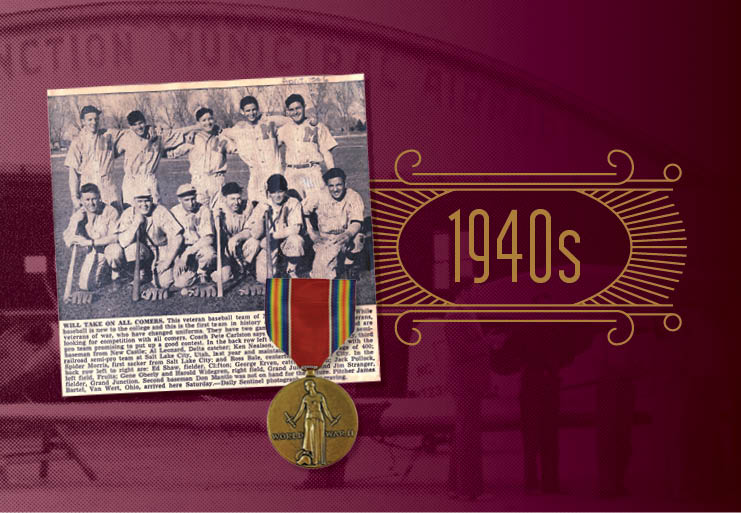
One example can be seen in a photograph published in a local paper celebrating the college’s first baseball team and “all the boys but one are veterans … who have changed uniforms.” War was not soon forgotten by these veterans but instead carried out in symbolic ways following their return to the U.S.
Serving Those Who Served
Eight decades later, CMU and the world are very different places. Enrollment after the war tripled to 550 in 1946 and today exceeds 10,000. And the support provided to CMU’s robust veterans community has expanded exponentially.
At the core of this support are programs aimed at financial assistance. The university’s Veteran Services office helps veterans gauge their eligibility and apply for benefits from the Department of Veterans Affairs.
“It’s such a great university for veterans,” said Cade Streich, who fields inquiries in CMU’s Veteran Services office. “The transition that occurs from the military to the university is very easy. We basically help students with anything.”
The most common assistance program accessed by today’s CMU veterans is the post-9/11 GI Bill® according to Veterans Benefits and Services Coordinator John Peresta. The resource is available to veterans with at least 90 days of service on or after September 11, 2001, and goes towards assisting
veteran students’ tuition and fees, housing, books and other costs. Beyond providing the opportunity to reassimilate with life post-service, the bill recognizes service by giving prospective learners the tools to gain new skills, achieve stability and contribute meaningfully to their communities and the workforce in a new way.
Streich, 28, from Delta, Colorado, served as a flight operations specialist at Fort Carson before enrolling at CMU. Now a third-year computer science student, he said the GI Bill® provides him with over $1,500 a month — a contribution that makes an enormous difference.
“I would not be going to college if it were not for the GI Bill®,” said Streich, who works with Taylor in CMU’s Veteran Services office. “It provides all the resources I need to be a full-time student.”
Peresta and his team are dedicated to helping students navigate applications and obtain the necessary resources.
“We are really adamant about continuous improvements, making the process easier for veterans to get benefits,” said Peresta.
CMU provides additional resources for veterans. For example, the Veteran Laptop Rental Program provides laptops for $50 in the spring and fall semesters. The CMU Educational Access Services program also ensures students with disabilities get extra time and an environment with reduced distractions when taking tests, while the Alumni and Career Services office provides career guidance and resources for finding a job.
One of the largest challenges returning veterans face is shifting from the predictable structure of military life to the more free-flowing rhythms of campus culture.
“It was kind of overwhelming,” Streich recalls. “In the civilian world, there is no safety net. You have to fight for yourself in a different way.”
Students like Streich find the most benefit in seeking out community. The Veteran’s Lounge in CMU’s oldest building, Houston Hall, is one of the venues that foster community and is a place where veterans can make spontaneous connections, receive mentoring or find a roommate to share expenses. Streich said he’s joined members of the Student Veterans Association, a student veteran-run club, when they’ve gone on river outings
and hikes.
“It kind of reminds me of a support group,” he said. “We ‘get’ each other.”
CMU has also provided Green Zone training for nearly four dozen staff and faculty to understand the emotional struggles that affect some veterans who’ve experienced combat, sexual assault or injuries. Green Zone emblems affixed to office door frames designate places where students can find a sympathetic listener and guidance to proper resources.
With service comes lifelong legacy and the pressure to fill the shoes of the members who came before them. CMU works to honor and remember its students who have been a part of history, ensuring they have the resources that allow them to thrive amongst the broader campus community. Their paths may look different, but their history dating back to the 1940s and beyond is just one of the many pillars that hold up CMU as a provider of an opportunity for a better life through education.