
CMU's Transformational Growth and Evolution as a Brand Reflects its Values, Culture and Maverick Spirit
Wonder Bread, Band-Aids, Canon, Snickers, Volkswagen and Maybelline are just a few products or brands that were started or thriving in the 1920s and 1930s. Birdseye brought frozen food to the U.S. A 3M engineer developed Scotch tape. Motorola produced the first car radio. DuPont invented Nylon, which was first used in toothbrushes and stockings. Hewlett-Packard was started in a garage and IBM introduced a new data processing machine.
Many of these items or brands still exist today, a century later. They exist because of their innovation, their ability to understand and meet their customers’ needs, and because of the people behind the brand who defined the culture.
In the heart of western Colorado, Colorado Mesa University stands today as a symbol of what’s possible. The modern-day university that educates more than 10,000 students and anchors Grand Junction’s cultural and economic landscape began much more modestly in 1925: a junior college with a single goal of expanding access to education on the Western Slope. The pioneers who started this institution could never have imagined where it would be 100 years later.
Throughout the past century, CMU has undergone a dramatic transformation, not just in size and stature but in identity. Through name changes, logo revisions, evolving mascots and a deepening set of values, CMU’s brand has mirrored its mission throughout the years: to provide students an opportunity for a better life through radical affordability and accessibility.
Opening in 1925, Grand Junction Junior College primarily served as a two-year school for local high school graduates seeking an affordable higher education close to home. The early years were defined by humble circumstances, strong support from the community, a practical approach to education and tenacious leaders — traits that resonate today.
The 1930s brought the first of five name changes from Grand Junction Junior College to Grand Junction State Junior College.
Along with the name change, other brand identifiers, which remain today, were established. Students decided on the school colors maroon and white. The Grand Junction Daily Sentinel ran a poll for institutional nicknames, which included Slopers, Terrors, Peaches, Meteors and Pioneers. Mavericks was ultimately selected, which eventually became the mascot and a defining name that has continued to shape the institution today.
The school as a brand is much more than a name, colors or mascot. It’s the values, culture and mission that has shaped this institution throughout the last century. It’s the people who overcame ongoing obstacles to continue providing an education to western Colorado students.
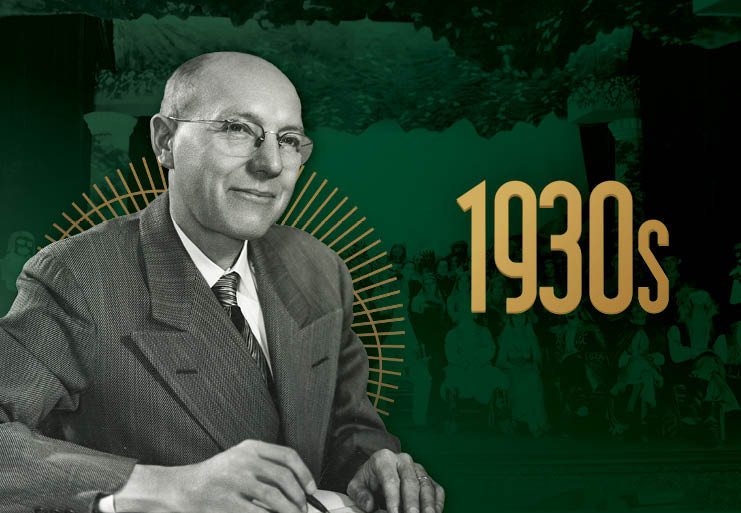
Key leaders from that era included Dean Clifford G. Houston, PhD, President Horace J. Wubben and Full-Time Instructor and Dean of Women Mary Rait, who in 1937 became the first, if not one of the first, female college vice presidents.
“I warn you right now, if you are employed by a small, new and growing college, you will find yourself doing all sorts of things before you are through with it. And some of them, I’m sure, are things you would have thought you would not or could not do, but they come up and one way or another you take care of them,” said Rait during a Museum of Western Colorado interview. “It has been a most worthwhile and most challenging experience.”
The perseverance and resolve of early leaders set the cultural foundation and focus on the mission to prioritize the needs of students above all else, which would evolve and would last for a century. Working with community leaders and local organizations was key to keeping the institution running through financial uncertainty and global upheaval of the time including the start of World War II. Key community partnerships and meaningful relationships are just as important today.
After the 1930s, the institution’s visual identity went through many changes, including a popular bellowing cow logo used in athletics. The mascot, which is one of the most highly recognizable institutional symbols, made its first appearance in the pages of a late 1940s yearbook. The first costume mascot included a papier-mâché head that was worn by students and one of the first live mascots was a calf named Mavericki. The Rowdy Mascot Program would eventually form in 2021 and now includes scholarships for performers who can be seen at nearly every major university event.
The school also continued its transformation with additional name changes including Mesa College from 1937 to 1988, to Mesa State College from 1988–2011 and one of the most significant and recent changes to Colorado Mesa University. The current name better reflects the breadth of academic offerings, including growing graduate programs, and captured a growing spirit on campus — a belief that CMU was no longer a small regional school but a dynamic institution capable of competing at a higher level in academics, athletics and student opportunities.
Under current President John Marshall, CMU is entering a new era as a Human Scale University — a university that is a model of the world it wants to create.
Through Forming the Future, a university-wide strategic planning process that started in 2022, the question became: “How does CMU know what world to create?”
“For CMU, agreeing on the kind of world we want to create is possible through our shared values, including love, dignity, courage, resilience, humility, curiosity and power,” said David Ludlam, senior vice president of communications. “Because everyone on campus works to embody these values, CMU is a place where a sense of belonging is afforded to everyone no matter who they are, where they are from or what they believe.”
Students, faculty, staff and administration worked together to outline CMU’s vision and mission and clearly defined what makes CMU unique. These uniques, or brand pillars, include an opportunity for a better life, radical affordability and teaching students how to think, not what to believe. These core tenets are not new for the institution but for the first time they were named, defined and provided a framework for how to talk about the culture of CMU.
From that institutional brand foundation came visual identity changes including a new CMU logo in 2024 and an expanded color palette, followed by a new font and design system in 2025. This new visual identity reflects who CMU is today, what the institution offers and why it matters.
Providing students with an opportunity for a better life is CMU’s promise and has been a foundation for the institution since the 1930s, which is reflected in this foreword for the 1932–33 Grand Junction State Junior College catalog:
"A democracy such as ours is constantly in need of intelligent leadership. Our greatest leaders in the past have not always come from families which could afford to educate their young men and women. Some of our greatest men and women have come from homes that were ‘poor’ from the standpoint of material wealth. The Junior College movement is an attempt to make available opportunities for at least a part of the higher education course, in the hope that promising students, having completed one-half of the course, will find it possible to complete.”
As CMU continues to transform throughout the next 100 years, so too will its identity. While name, logos and colors may be refined, and faculty, staff and students will come and go, one constant will remain: the Maverick spirit and heart that has defined this institution for a century will carry on thanks to its core values that have stood the test of time.