
CMU's Focus on Performing Arts Is Evident Throughout Decades of Growth, Creativity and Community
For years, performing arts has been an important part of life at Colorado Mesa University. Today, the arts at CMU have grown into a thriving hub for theater, music and dance. The programs have expanded in both scope and reputation, which has helped bring world-class performances to the community.
Humble Beginnings
The performing arts at CMU can trace their roots back to the early junior college days when theater was primarily an extracurricular activity for students. From 1929 to 1936, junior college students interested in drama performed an operetta each year in the spring, either at the Avalon Theatre or the Mesa Theater, both located in downtown Grand Junction.
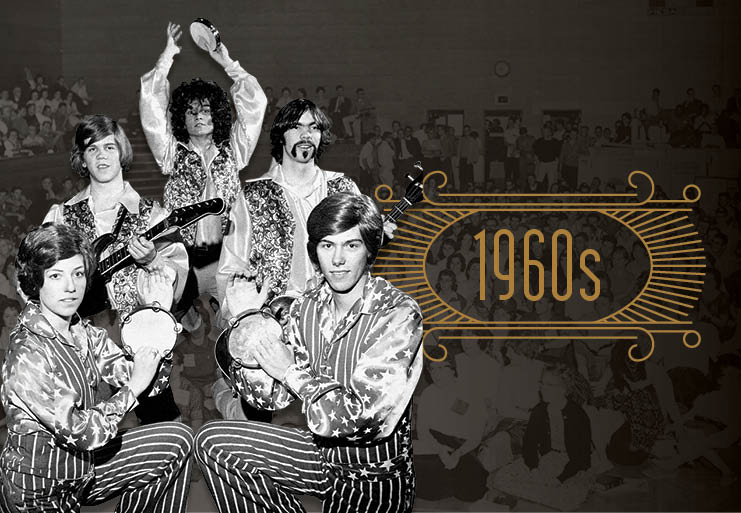
It wasn’t until 1960, when Bill Robinson accepted a speech and drama teacher position at the junior college, that the performing arts at Mesa College started to take off and become the successful programs of today. Robinson was a performer and teacher with his own Broadway aspirations and brought professional-level training to the college where he would later become the head of the Department of Theatre Arts.
In 1969, the Walter Walker Fine Arts Center, now known as the Moss Performing Arts Center, was constructed and became the home of Mesa’s fine arts and speech majors. The dedication ceremony for the building in November 1969 featured US Supreme Court Justice Byron “Whizzer” White as the keynote speaker and was accompanied by a production of Thornton Wilder’s The Skin of Our Teeth, directed by Robinson and starring off-Broadway star Eulalie Noble. Mesa students paid 25 cents for their tickets and community members were charged $1.
Having a dedicated space on campus elevated the arts program, providing students with a professional environment to rehearse, perform and study, while also expanding opportunities for the community to engage with the performing arts.
New Programs Take Root
In 1971, Robinson launched the college’s Summer Theatre Program, a repertory series that quickly became a community favorite. Students and faculty staged three to four productions in just six weeks, rotating the shows throughout the summer. The program provided audiences with a steady stream of entertainment while offering students the opportunity to refine their skills in a fast-paced, professional environment.
That same decade, Ann J. Sanders laid the foundation for what would become CMU’s dance program. Starting from scratch in the early 1970s, Sanders gradually built the program throughout the years, guiding it from its inception in the kinesiology department to its later integration with the theatre arts department in the 1990s. Her work ultimately led to CMU’s first bachelor’s degree in dance.
Sanders’ vision and Robinson’s leadership in theater set the stage for decades of artistic growth at CMU, ensuring that the performing arts were present and thriving on campus and throughout the Grand Junction community.
Growth Continues
In the 1992–93 school year, the campus paid tribute to Robinson’s decades of leadership by naming the main theater in the Walker Fine Arts Center after him. The renaming of the theater was “one of the most gratifying highlights of my teaching and performance career,” wrote Robinson in his self-written
2015 obituary.
The 1990s marked a period of experimentation and strong community ties. Students gained exposure to guest artists and workshops while continuing the mentorship culture that Robinson and other faculty had fostered.
Laura Bradley, who attended the program in the mid-90s, remembered how immersive the experience was, particularly through the Summer Theatre Program.
“I remember how intensive it was,” Bradley said. “We were all doing costumes, helping with sets and rehearsing for a show, then performing a different show that night. It was so fun.”
Students often built their own props and costumes and occasionally staged productions in unconventional spaces when the theater was unavailable.
“So much of what we were doing was initiated and created by us,” Bradley said.
Juli Jacobson, a 1993 graduate of the Musical Theatre Performance program, remembers the collaborative atmosphere that spanned across disciplines.
“The facility was much, much smaller than it is now, so music and theatre were all in one small place together,” she said. “Theatre students were also in choir, and music students were also in musicals, so everybody was stuffed together into this one building before it was renovated.”
New Century, New Era
The early 2000s ushered in a new era for the performing arts at CMU. In November 2002, the Walker Fine Arts Center was renovated and expanded, then renamed the Moss Performing Arts Center in honor of benefactors John and Angie Moss. Their financial gift made the completion of the facility and the addition of a dedicated dance studio possible.
That same year, art students who had been sharing the space moved into their own building, now known as the Jac Kephart Fine Arts Building. The transition freed up space at Moss, allowing the performing arts to grow.
The Moss Performing Arts Center (MPAC) became the new hub of activity for music, theater and dance. It featured the Robinson Theatre, Love Recital Hall and the Mesa Experimental Theatre, providing venues for large productions, intimate performances and student-driven experimental work.
For alums like Jacobson, the renovation of MPAC was a turning point.
“When Moss Performing Arts Center was updated and that vision came to life, it was an ‘aha’ moment,” said Jacobson. “The new spaces created room for everything to grow. It showed how much the arts matter here.”
The decade bore witness to growth in student enrollment and a wider variety of productions, including non-traditional shows in the newly added Mesa Experimental Theatre. Outreach efforts and public performances strengthened the program’s connection to the community and put performers in front of broader audiences.
Additional upgrades to MPAC in 2009 and 2012 expanded opportunities even further, with the addition of the scene shop, costume shop and a new dance studio that was later named after Ann J. Sanders, recognizing her contributions to shaping CMU’s dance students and curriculum.
As the program expanded, both its curriculum and production quality improved, allowing students to benefit from mentorship opportunities and gain experience in a range of settings, from large-scale musicals to intimate student-led performances. Alumni stayed connected to the program through ongoing support via the Bravo Club and Encore Club, helping ensure that CMU’s performing arts continued to thrive.
Asteria Theatre and World-Class Performances
The growth didn’t stop there. In 2024, CMU celebrated the completion of the Asteria Theatre, a state-of-the-art performing arts center designed to host both university productions and professional touring acts. The theatre opened with a CMU Theatre production of Amadeus, directed by Head of the Department of Theatre Arts Mo LaMee. During the performance, audiences were able to experience the venue and its advanced technology for the first time.
The opening of the Asteria Theatre established it as the largest performance venue between Denver and Salt Lake City, a milestone for both CMU and the Western Slope community. For the first time, students could train and perform in a space on par with major metropolitan theatres while local audiences gained access to programming previously available only in larger cities. The theatre elevated the standard for campus productions and expanded the possibilities for the arts throughout the region.
This year, CMU announced the Asteria Broadway Series, bringing world-class theatrical performances to western Colorado for the first time. The 2025–26 season features six acclaimed productions, including Mrs. Doubtfire, TINA – The Tina Turner Musical, Mark Twain Tonight!, THE BOOK OF MORMON, Chicago and Hadestown.
“When we proposed Asteria Theatre, we envisioned a venue and learning space that would bring Broadway-caliber performances to our region,” said CMU President John Marshall. “Following our grand opening of the theatre with Amadeus, the Asteria Broadway Series brings the original vision full circle, offering western Colorado access to extraordinary cultural experiences right here on campus.”
From its humble beginnings with small junior college productions to its current status as a hub for professional-level performance and education, CMU’s performing arts have come a long way. With state-of-the-art facilities, visionary leadership and strong community support, the program is prepared to continue inspiring students and audiences for years to come.