
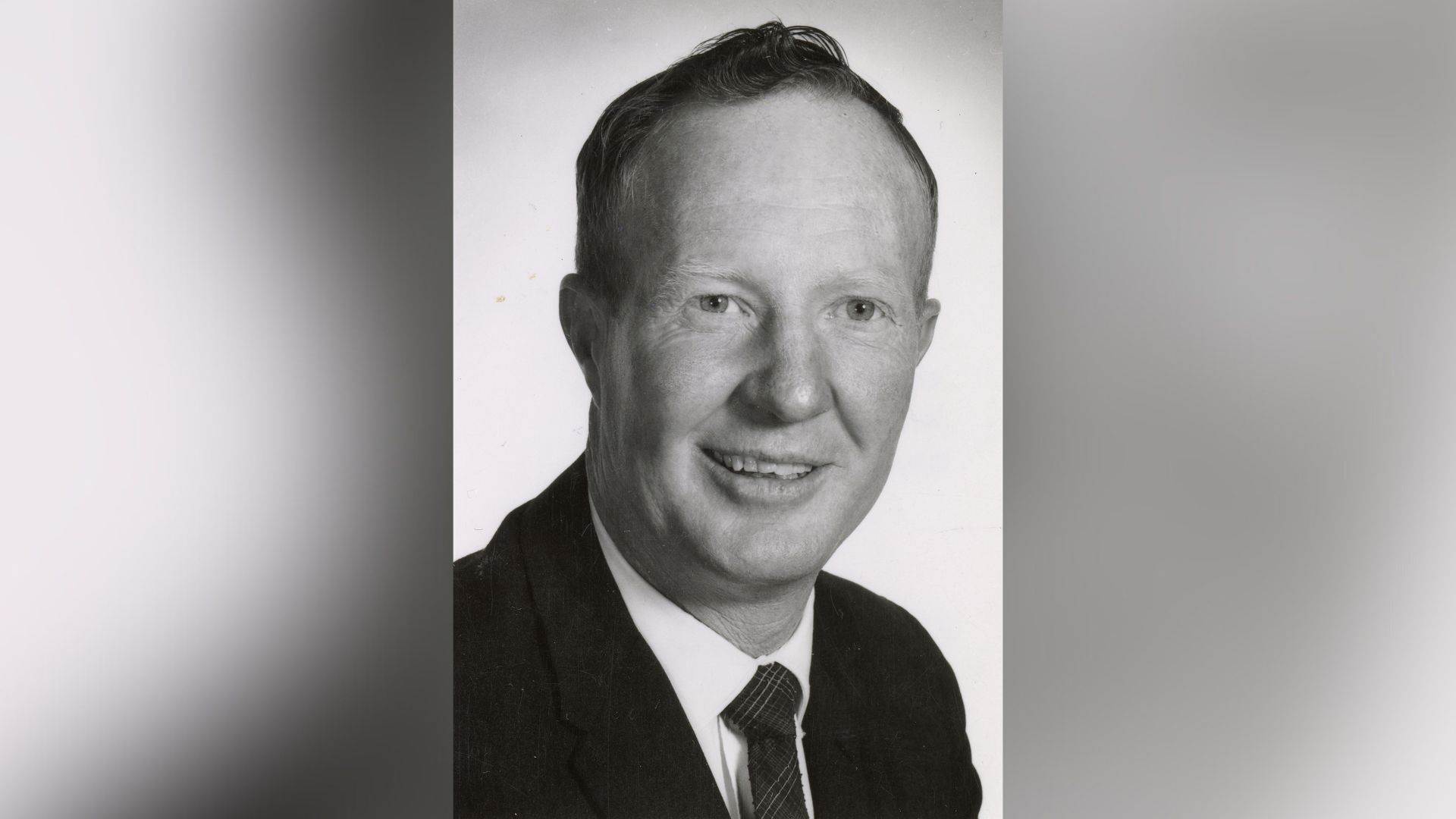
Student-Athlete, Coach, Administrator
In a 1993 oral history interview, an undercurrent of laughter runs through almost everything Jack Scott says. A self-described jokester, Scott shared anecdotes from his long career at Mesa, first as a student and then as an employee working his way up from housing to the registrar’s office to admissions. While not all of Scott’s stories remain appropriate — a fact he bemoaned — his joy in life and his ability to see humor in most situations are inspirational.
Scott’s family moved to Grand Junction from Dust Bowl-era Oklahoma when he was nine. When he enrolled at Mesa College in 1941, he was admittedly more interested in sports than academics. Drafted into World War II at nineteen, he served as a paratrooper in Europe and transported war criminals to the Nuremberg trials before returning to Mesa to finish his degree.
A talented basketball player, Scott graduated from Mesa with numerous basketball wins and awards under his belt. He was all-conference for two years, top five scoring in two years and was nicknamed ‘Smiley’ for his positive attitude on the court,” according to his 2019The Daily Sentinel obituary.
Looking back on his college days, Scott reminisced that about 80 percent of students went to basketball games, 90 percent went to football games, and everyone went to the dances. Tuition and fees were fifteen dollars a quarter, and the faculty was “outstanding.”One of his favorites was Miss Herr, head of the English department. “I’ll never forget the first essay that I sent to her,” he said. “She had more in red writing than I did in black writing when she handed it back to me.”
In 1963, Scott returned to Mesa as an employee. He worked for Dr. Lowell Heiny and stepped back onto the basketball court, coaching with Wayne Nelson. When Dr. Lowell Heiny became a vice president, Scott stepped into his role as a director of admissions and records, eventually becoming Mesa’s first stand-alone director of admissions. During the early 1980s, he coached the women's basketball team, earning their admiration by procuring new uniforms.
During his early career, Scott recalled “piles and piles of paper and books” in his office, along with registration lines “thirty miles long.”One particularly unenviable task was staying up late the night before graduation to double-check grades and telling a handful of unlucky students that they wouldn’t be walking just hours before the ceremony.
In the 1960s, Scott worked the door at the college center for Sunday lunch. “Every boy had to wear a tie, and every girl had to dress up in a dress,” he shared. “You couldn’t get in with Levi’s. You didn’t have a choice.” Dorm living was mandatory unless there were no vacancies. Then, students could move into supervised housing. “It was one of my jobs to check on the houses,” he said, recalling one home that was decorated with “floor-to-ceiling beer cans, stacked one on top of the other, all around the room.” Tenants of another house got wind that he was coming to inspect. “And there they were at the table,” he exclaimed. “They had the Bible and candles going, ties on. It was so funny, you just couldn’t help but laugh.
”Wrapping things up with student interviewer Diana Jones back in 1993, Scott shared that he continued to receive letters from former students.“People are proud to say, ‘I went to Mesa, the best education I got was at Mesa,’” he recalled. “I think that’s a real feather in their hats.”
A Story 100 Years in the Making