
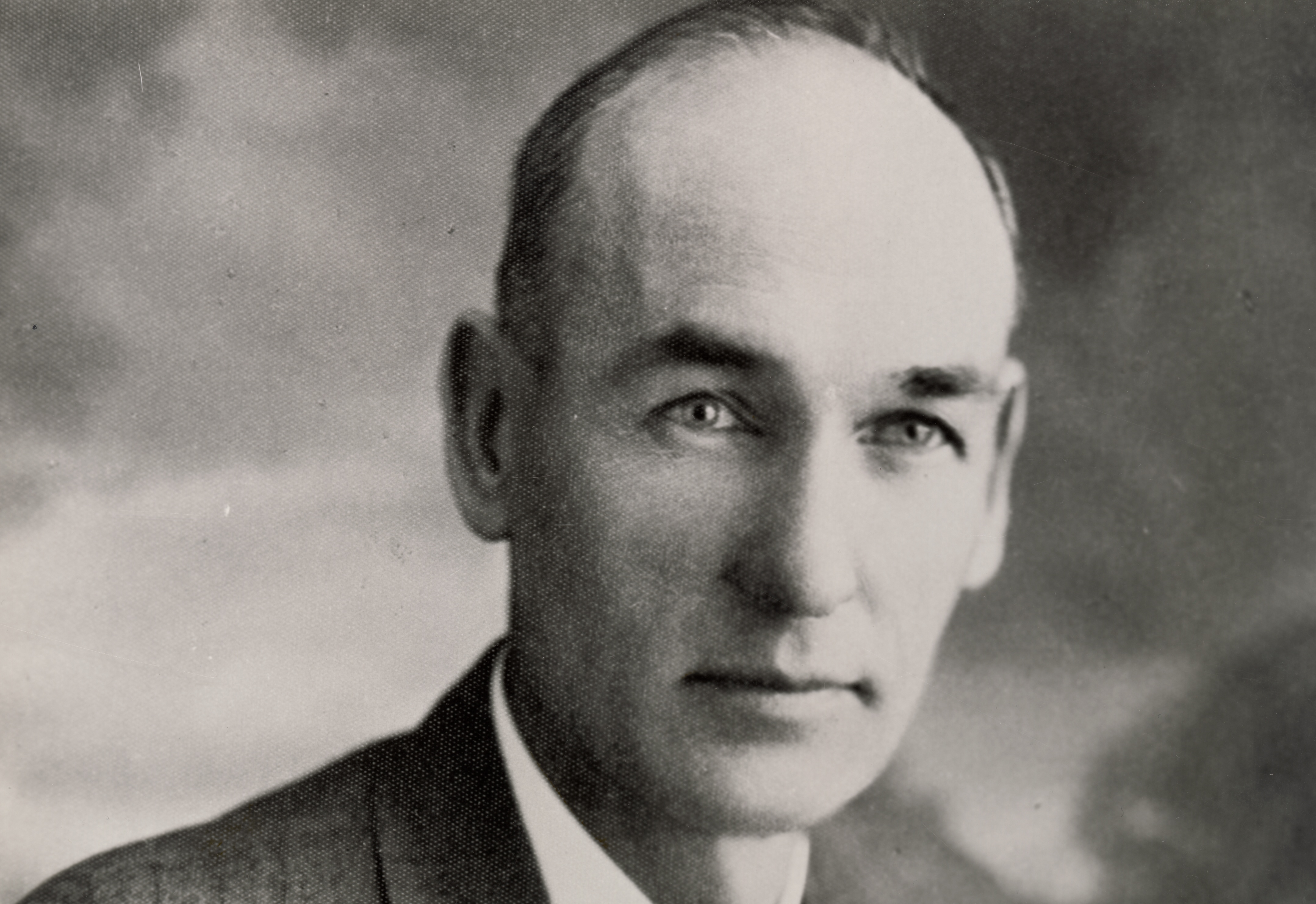
The Father of CMU
Richard E. Tope believed in education and devoted his life to it. During his career, he was a successful high school principal and school superintendent. He was also one of Mesa College’s earliest supporters and boosters, and this commitment lasted throughout his lifetime.
Born in Ohio in 1876, Tope and his wife, Elizabeth, relocated to Grand Junction in 1911 when he became principal of Grand Junction High School, a role he held for seven years. From his earliest days in the Grand Valley, Tope distinguished himself as a community leader, a businessman with diverse interests, and a charter member of the Grand Junction Rotary Club, which held great sway over local affairs.
In 1918, Tope became superintendent of the Grand Junction schools and a champion for the establishment of a local college. When legislation passed in 1925, Tope stepped up to assist the new junior college.
With just a few months to get organized, Tope recalled the urgency of getting the college’s doors open.
“We were assured of a goodly number of Freshman students. In advance we would need books, furniture, and some changes in the old Lowell school,” he wrote in a history of the Grand Junction Rotary Club.
In that history, Tope details the actions he personally took, including enticing the county to grade and clean the school site, cooperating with the University of Colorado to have chemistry tables shipped across the mountains, locating sufficient furniture, and purchasing textbooks and manuals that would be sold to students at cost. In addition, Tope donated the expertise of four high school teachers, releasing them to teach part-time at the new college while being paid by the school district.
In recognition of his leadership, Colorado Governor Shoup appointed Tope as one of three original college trustees.
Tope’s support of Mesa College went beyond his official capacities. Funding for the new college was scarce and came almost entirely from local sources, not the state. Tope was a member of the “Hundred Dollar a Year Club,” which was credited in his history of Grand Junction with “saving the life of the college.” He was also one of several Rotarians who signed a note in 1929 guaranteeing payment to help the college get out of debt, and for seven year she taught extension classes for teachers and donated his pay of five dollars per student to the junior college fund.
In addition to believing in education, Tope believed in the power of history. After retiring from the school district in 1938, he wrote a history of local K–12 education, a history of the Grand Junction Rotary Club, and the “Objective History of Grand Junction,” which he prepared in 1957 to celebrate the city’s 75th anniversary.
Summarizing the establishment and growth of Mesa College, Tope recalled that the push for local higher education began in 1904 as residents grew frustrated with the lack of opportunities in western Colorado.
“Mesa College we now have,” he wrote. “It is supported by the whole people and the service it renders meets the fondest dreams of the unyielding and resolute ideas of those pioneers who knew no such word as fail.”
In honor of Tope’s contributions to local education, Tope Elementary School was named for him when it opened in 1941, and there are two Tope family scholarships for CMU Students: the Richard E. Tope Memorial Scholarship created by his son Dwight Tope, and the Dwight & Carolyn Tope Endowed Scholarship Fund created by R. E. Tope’s grandson Rock Tope in honor of his parents. Richard E. Tope passed away in 1962.
A Story 100 Years in the Making
Want to learn more about CMU's history? On August 16th, The Maverick store will launch a pre-sale for Colorado Mesa University - A Century of the Maverick Spirit, written by Amber J. D'Ambrosio and Kristen Lummis. The 192-page book chronicles CMU's 100-year journey of growth, resilience and community impact, celebrating the people and moments that shaped our Maverick history.
CMU's Century Project honors one hundred years of Colorado Mesa University's rich history - celebrating the people, milestones and spirit that have shaped our enduring legacy. As we reflect on this meaningful milestone, proceeds from the commemorative Century Book and events throughout the year will benefit the Century Scholarship, ensuring that future generations of CMU students can continue to grow, learn, and carry the CMU legacy forward.
Pre-sale will be available on August 16th.