
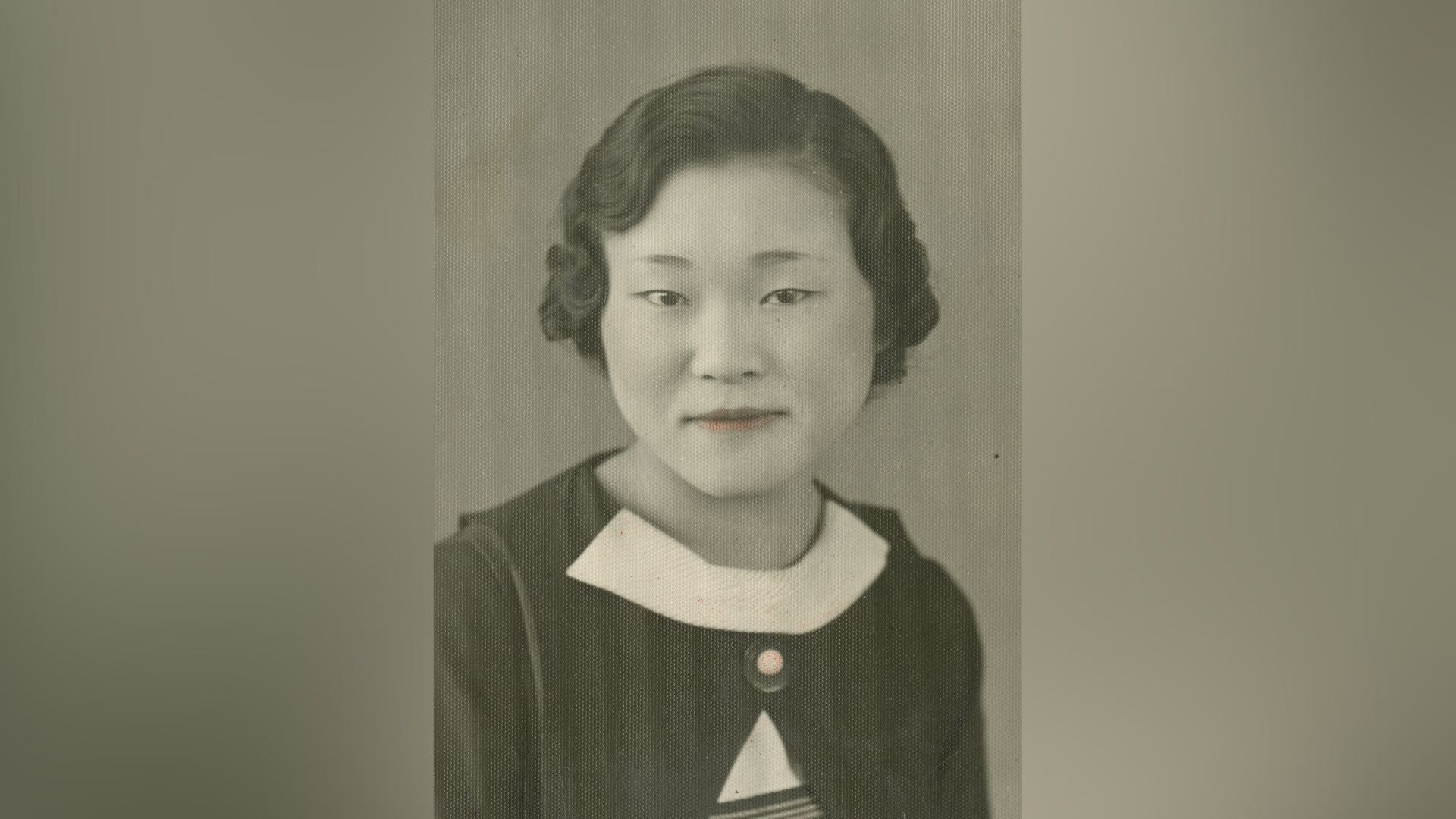
Helping Win WWII
When Trooda “Trudy” Oda Hirokawa died in 2002 at the age of eighty-two, the Grand Junction Daily Sentinel published a single paragraph. It mentioned that she had formerly lived in Grand Junction and that she retired from work as a clerk with the Denver Automobile Dealers Association.
Oda Hirokawa’s story was so much more than that.
Oda was born in 1919 in Grand Junction. Her parents were Japanese immigrants who farmed in an area of the Grand Valley known as Pomona. She was the second of seven children, and after graduating from Grand Junction High School, she attended Mesa College from 1937 to 1939, studying music and music education. Oda was a violinist, and a photograph from the late 1930s shows her with the Mesa College Orchestra on stage at the Mesa Theatre on Main Street. In 1940, Oda transferred to the University of Colorado (CU) to complete her degree.
In December 1941, the United States entered World War II, and by February 1942, President Franklin Roosevelt had signed an executive order to relocate Japanese Americans living on the West Coast to inland concentration camps.
Colorado’s Governor Ralph Carr was initially the only western-state governor to agree to the forced relocation, welcoming Japanese Americans to Colorado. When other governors balked at accepting the supposed “enemy” within their state lines, Carr felt it was his duty to house the relocated safely at the Amache-Granada Relocation Center, publicly stating that “if you harm them, you must first harm me.” At the same time, he vociferously and publicly denounced the practice as illegal, unconstitutional, and counter to American ideals. He publicly invited Japanese Americans to relocate in Colorado and he stood fast against calls to inter Colorado’s Japanese American population, none of whom were covered by Roosevelt’s executive order. In 1942, he ran for the United States Senate and was defeated. His support of Japanese Americans played a large part in his loss. In 1999, Carr was posthumously named “Colorado’s Person of the Century” by The Denver Post.
It was during this tumultuous time, in the spring of 1942, that Oda graduated from CU with a bachelor’s degree in music education. She stayed in Boulder for her student teaching and joined the Red Cross Nurse’s Aide Corps. In 1944, she joined the Women’s Army Corps (WAC) and was posted in Iowa and Indiana. Her enlistment in the WAC was duly and proudly noted in the Grand Junction newspaper. In the fall of 1944, declassified US Army documents show that Oda was one of fourteen Japanese American WAC members chosen for their “sufficient knowledge of the Japanese language” to replace men as translators in the Military Intelligence Service and to receive security clearance for these duties. She was transferred at this time to Fort Snelling, Minnesota.
Oda met her future husband, Henry Hirokawa, during their military service. Hirokawa served with the 442nd Regimental Combat Team, a segregated Japanese American army infantry unit, two-thirds of which was made up of Japanese American men from Hawaii, including Hirokawa. The 442nd fought in Europe beginning in June 1944, helping to liberate France and drive German forces out of northern Italy alongside the 92nd Infantry Division, a segregated African American army unit.
Oda and Hirokawa were married in Hagerstown, Maryland, on Christmas Eve in 1945. They returned to Colorado, settling in Lakewood, and had one son, Masami Hirokawa. Despite the large amount of archival material maintained by History Colorado, including scrapbooks and photo albums documenting Oda Hirokawa’s life in Mesa County and her time at Mesa College, very little is known of her life in Lakewood.
A Story 100 Years in the Making