
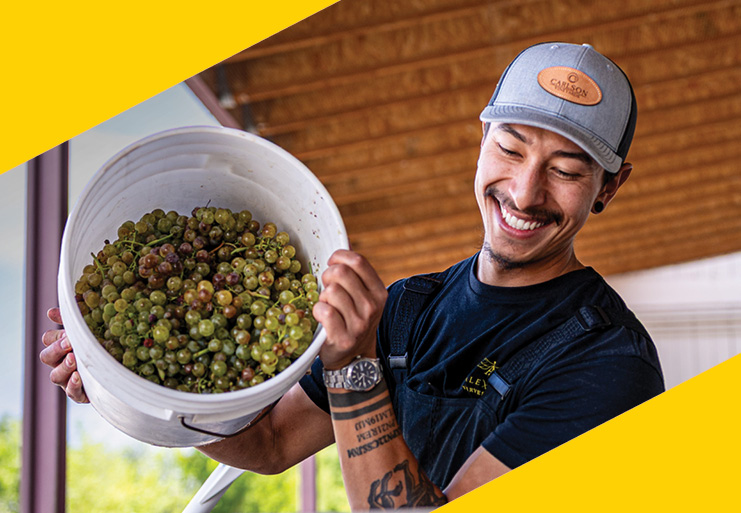
CMU Tech alumnus Matt Guerrero turns hands-on training into a career in Colorado wine
Matt Guerrero didn’t come to CMU Tech with a lifelong plan to become a winemaker, but he knew he wanted a career where he could have a direct hand in the work.
“I knew I didn’t want to be in an office somewhere,” Guerrero said. “I wanted to be hands-on in what I was doing.”
A few years later, his career took him from Palisade, Colorado, to harvests in California and Oregon, then back to Palisade, where he now works as an assistant winemaker at Carlson Vineyards.
At Carlson Vineyards, Guerrero’s days change with the season. Harvest brings long hours as grapes arrive and production begins. The rest of the year is spent checking finished wines, preparing for bottling and making sure each product is ready before it hits the shelves.
Guerrero grew up in Fort Collins, Colorado, and already had Colorado Mesa University in mind when he started looking at colleges. His brother had attended CMU, so the university felt like a natural starting point. As he explored programs, CMU Tech’s Viticulture and Enology program stood out because it combined several of his interests, including agriculture, chemistry, production, business and hospitality.
CMU Tech is the only college in Colorado to offer an Associate of Applied Science in Viticulture and Enology. The program also offers technical certificates for students interested in different parts of the wine industry.
Viticulture focuses on grape growing, while enology focuses on winemaking. Garrett Portra, technical instructor of viticulture and enology at CMU Tech and owner of Carlson Vineyards, said students need to understand each step of the process.
“We touch on all that is wine,” Portra said. “It starts in the vineyard and goes all the way to a finished bottled product at the end.”
With about 150 wineries and more than 1,000 acres of vineyards in Colorado, the program also connects students to a growing part of the state’s agricultural economy. At CMU Tech, students learn sustainable viticulture, fermentation, sensory analysis, wine production and the business and marketing practices connected to winery operations.
For Guerrero, the program helped explain the “why” behind the work. In class, he learned how different winemaking choices could affect the final product. Through his internship at Carlson Vineyards, he began to understand how those concepts worked on a larger scale.
“In the program, everything was definitely a lot more small-scale,” Guerrero said. “There was a portion of it that was very theoretical, so you’re learning the ‘why’ of winemaking.”
Students in the program make wine in the lab outside their classroom, where they pick grapes, crush them, ferment them and bottle the wine. They also spend time in real vineyards and winery environments through field trips, where they apply classroom knowledge to harvest work all the way through production.
One recent example is Rowdy Red, a student-made wine developed through CMU Tech’s Viticulture and Enology program in partnership with Carlson Vineyards. Students helped blend, bottle and label the wine, gaining experience with a product that is now available on local shelves and in tasting rooms.
For Portra, projects like Rowdy Red help students understand the difference between learning about wine production and doing the work on a commercial scale.
“It’s taking that theoretical side, that small-scale production that we’re teaching them, and giving them a chance to get out and see the difference between making wine in a six- or 10-gallon batch and making wine in a 500- or 1,000-gallon batch,” Portra said.
Guerrero said the program also gave him a better understanding of how much work goes into each bottle. After completing CMU Tech’s program, Guerrero worked a harvest at Calera Wine Company in California. He later completed two harvest internships at Alexana Winery in Oregon while earning a bachelor’s degree in food science and sustainable technologies, with a focus in enology and viticulture and a minor in chemistry.
Those experiences exposed him to different mentors, cellar practices and ways of approaching harvest. Still, Guerrero knew he wanted to return to the Grand Valley.
“I knew when I left Colorado the first time to go try wine in different states, I wanted to come back,” Guerrero said. “I really liked the culture that was out here, and all the wineries had really great people behind them.”
For Portra, Guerrero’s experience in Colorado, California and Oregon reflects the kind of preparation the program is meant to provide.
“We’re a program that prepares you to work in the world of wine wherever you want, wherever it takes you,” Portra said.
Now, Guerrero is making wine in the same region where he earned his degree and working in the wine community that helped him get started.