
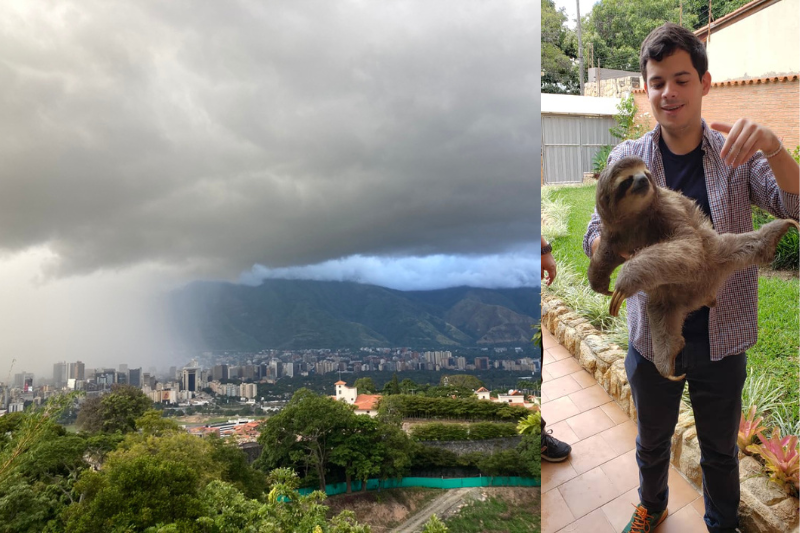
CMU biology student Augusto Latorre presented at the February Cultural Café on his home country Venezuela
On Feb.17, 2026, Colorado Mesa University biology major Augusto Latorre presented at a monthly Cultural Café event to share information about his home country, Venezuela. Latorre has lived in the United States for 18 years and is a third-generation immigrant. His grandfather emigrated from Portugal, and his father immigrated from Ecuador to Venezuela. Originally from Caracas, Venezuela — which he described as being similar to Grand Junction in that it lives in a valley — Latorre is driven by the idea that there is something new to learn everywhere you go, and shared such during his presentation.
Latorre’s presentation covered a range of topics informing attendees about what life looks like in Venezuela, from food, music and dance to the biodiversity of the land and the people who have inhabited it.
Latorre’s passion for biology was evident in his presentation, as he went into detail about Venezuela’s rich and vibrant vegetation and diversity in land types. He described flat-topped mountains, called tepuis, which appear to be “islands above the rainforest.” The peaks of the mountains contain unique pockets of life that may differ from one “island” to the next, and many native Indigenous people, or Pemones, do not venture to the top because they consider these spaces to be sacred.
The Tepui mountains are not the only feature unique to Latorre’s homeland. In his presentation, he highlighted the Orinoco River, a major water source that settlements have gravitated towards throughout history.
“The Orinoco River shaped culture in the country; settlements happened around this river. These settlements brought diversity and richness to us as humans,” shared Latorre.
Before Venezuela was colonized, diverse groups of tribes lived across the land, one of which built their communities along the banks of Lake Maracaibo. When Italian explorer Amerigo Vespucci discovered these inhabitants, he thought the lifestyle mirrored that of Venice. Venezuela translates to “Little Venice.”
Latorre also shared information about his home country’s array of fruits, like mangos, which he and his siblings would eat by the dozen some days. The country gets a lot of rain, making it easy for a variety of flora and fauna to grow and thrive, like papayas, pomegranates, coffee and cocoa beans.
Latorre was inspired to study biology because he had paid special attention to the lush diversity of life on Earth. His curiosity has led him to study pathogens in wastewater and ants in Loma. His research in Loma introduced him to the Western Slope, which is how he found Grand Junction as his new destination for study.
When asked why the campus community should attend Cultural Café events, Latorre said, “Because it’s always so interesting to learn about different cultures. It's enriching and it shows us different perspectives and things that are different, but in those differences, there is also typically a lot of similarities.”
The next Cultural Café event will feature a student from Italy. The event will be held in the Center for Teaching and Learning at Tomlinson Library on March 26, from 12:30-1:30 pm. Attendees can enjoy presentations with food and a beverage inspired by the country featured. The event is free and everyone is welcome to learn more from the people who come from around the world and discover a little slice of home at CMU.