
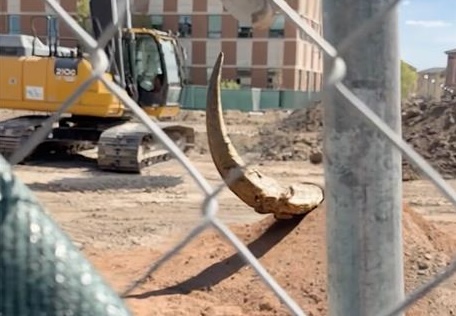
April Fools! Geo Exchange construction paused after a mysterious specimen was found
Construction crews working near Colorado Mesa University’s rugby field made an unexpected discovery this morning when excavation tied to the campus Geo Exchange project uncovered what appears to be a large fossilized specimen.
Shaw Construction has since paused work in the area to allow campus experts time to observe the site and begin a closer examination of the find.
Early observations suggested the unearthed remains may belong to Maverikus Maximus, a long-theorized prehistoric species that some researchers believe may have survived the Permian-Triassic extinction event.
Professor of Geology Greg Baker, PhD, said the discovery has already generated excitement among faculty in the Physical and Environmental Sciences department.
“When you can find a fossil of any kind, especially a new kind of fossil, it's world-bending. As soon as I heard, I got out there and wanted to start looking around to see what they had out there,” said Baker.
While Baker stopped short of confirming the identity of the specimen, he said researchers have long theorized the existence of Maverikus Maximus despite never having secured a sample.
“We’ve hypothesized the existence of this creature, but we’ve actually never found tangible specimens,” said Baker.
Part of that theory centers on the fossil’s connection to a little-known maroon and gold mineral called spiritite, which he said appears to have a strong connection to concentrated campus energy.
“Most people are unaware of it, but it seems to have some kind of anthropogenic link,” Baker said. “We’re starting to get some traces of it. I was just out there earlier today shooting some measurements, and we’ve got some pretty hot signal out there.”
According to Baker, the fossil’s unusually shallow location, paired with the uptick in campus enrollment numbers, may also be tied to the discovery of the fossil.
“We think that a combination of increased student traffic as Colorado Mesa University has grown over the years, along with Geo Exchange construction, has created what we call thixotropic behavior in the subsurface,” Baker said. “That disturbance, along with its association with the spiritite mineral, may have allowed the fossil to migrate to the surface, where it could finally be detected.”
If confirmed, the discovery could reshape what scientists thought they knew about the species' origins and raise new questions about whether it ever truly went extinct.
“Some people think it may not have gone extinct,” Baker said. “Some have suggested this thing may still be alive in places, although potentially quite different in form.”
The discovery comes at a time of continued momentum on campus, with ongoing campus improvements and a steadily growing student body known for its pride, energy and deep-rooted Maverick spirit.
After further review, campus experts confirmed the specimen is indeed the Maverikus Maximus, a rare but entirely fictional species known for thriving on campus spirit.
Happy April Fools’ Day, CMU!